Skills Impact held a Skills Service Organisation (SSO) role between 2016 and 2022. In 2023 we established one of ten Job and Skills Councils (JSCs), after a submission to move into the role was backed by over 200 letters of support from a broad range of industry stakeholders. This new JSC, Skills Insight, has a broader scope to deliver outcomes that support a responsive VET system and a skilled and resilient national workforce. The industry coverage of Skills Insight is similar to our past coverage as a Skills Service Organisation.
In 2019, the Animal Care and Management IRC commissioned an Equine Industry Survey to ascertain how work with equines is being done and who is doing that work. While several representative bodies have strong views on scope of practice, the survey was designed to provide evidence of the type and nature of services being accessed by equine owners, carers, trainers, riders and others responsible for the day to day welfare of equines. The combination of direct consultations, the equine survey, workshops and other feedback mechanisms identified issues to be addresses as part of this project. This included the need to strengthen skills in horse safety, behaviour and welfare, and the need to recognise the many transferable skills across sectors involved in the care of equines.As part of this project units of competency in a range of horse care sectors will be updated to embed horse safety, behaviour and welfare skills for specific job tasks. This will reflect the holistic approach to equine welfare that survey participants overwhelmingly requested. Consideration will also be given to repackaging the skills standards to enable a variety of job outcomes and reduce complexity. To achieve this, a ‘job family’ is being proposed by the IRC to reflect the ‘equine care’ sector, which groups a range of current and emerging occupations, such as performance horse (equestrian events), rescue centres, sanctuaries, agistments, and allied health services (massage, body workers, saddle/equipment fitting, dentistry).
The Equine Industry Survey received 546 responses, with the following key findings:
The skills most in demand are associated with horse safety, animal behaviour and animal welfare.
A shortage of skilled labour was mentioned in reference to specific occupations, including farriers, track (including exercise) riders, grooms and saddle fitters.
There were calls for workplace-based training and practical skills, although some scepticism is expressed about its effectiveness given the lack of regulation in these areas of the industry.
It is difficult to access equine services in regional, rural and remote areas. Many customers feel limited to ‘what they can get’, bemoaning the reliability of, or waiting times for, providers who service broad geographical areas.
There continues to be specific labour force shortages, especially regarding farriers and track riders. These shortages are sometimes addressed by unqualified service providers, who are of varying quality.
One key purpose of the survey was to establish the current use of equine dentistry in Australia. Most respondents (95%) to the IRC survey said they engage service providers for equine dental care, indicating widespread knowledge of the importance of horses’ teeth to their overall health and the ongoing demand for services. The majority (53%) selected equine dental technicians as their service provider, while veterinarians were engaged by 23% of respondents. Around 24% arranged for both equine dental technicians and veterinarians to be present.
The Australian Industry Skills Committee (AISC) approved this project, out of the Annual Update IRC Skills Forecast and Proposed Schedule of Work.Skills Impact and the Animal Care and Management Industry Reference Committee (IRC) will oversee this project, consistent with the 2012 Standards for Training Package Development.Download Project Proposal (see page 38)
Register your interest in the project
Subscribe to the Skills Impact newsletter to keep informed about project updates. Make sure to select ‘Animal Care and Management’ as your industry of interest on the subscription form.
From a stablehand or groom, to a saddle fitter, nutritionist, massage therapist or equine dentist, a career working with horses can lead down many different paths. Even so, caring for horses is not a solo endeavour, requiring input from a range of individuals with specific expertise. Particular skills are required to make sure a horse’s teeth, body and hooves are healthy, that the equipment used is appropriate and safe, and that all their basic needs are met. Across all these roles, whether someone has grown up with horses or started their equine career in the classroom, skills in safety are an integral part of providing care to horses, protecting equine professionals and those around them in all their interactions with horses.Particular safety considerations will vary depending on job role and task, as well as environment, equipment, the horse’s work and health history, and who else is sharing the space. It is essential that these variables are addressed in national qualifications and skills standards, so the next generation of horse care workers can gain the expertise they need to work safety and effectively with horses.
In 2019, Skills Impact undertook a survey to explore the types of horse care services used, who is carrying out this work and how, and the skills and knowledge workers and owners possess and develop. From the 546 responses, it was affirmed that safety, animal behaviour and animal welfare are key skills for this kind of work. However, industry indicated that there could be a better way to incorporate safety and care skills in current qualifications, skills set and units, so that it is consolidated throughout the learning journey as a key element of this work.The survey also indicated that some skills areas, such as allied health services like nutrition and massage, are not currently defined by nationally endorsed skills standards. There is also a need to consider how to provide better access for people pursuing a career working with horses and support more flexible career pathways along the way. Skills standards and qualifications are required to support school leavers right through to professional occupations and leadership and management roles.As part of this project, the skills requirements of those who provide horse care services will be considered, so that they can be described in consistent skills standards agreed upon by industry. There are many experts with years of experience in Australia’s horse care industry. If you are experienced and knowledgeable about the care of horses, this is your chance to support future industry leaders, by defining the essential and necessary skills for various jobs in the horse care industry.
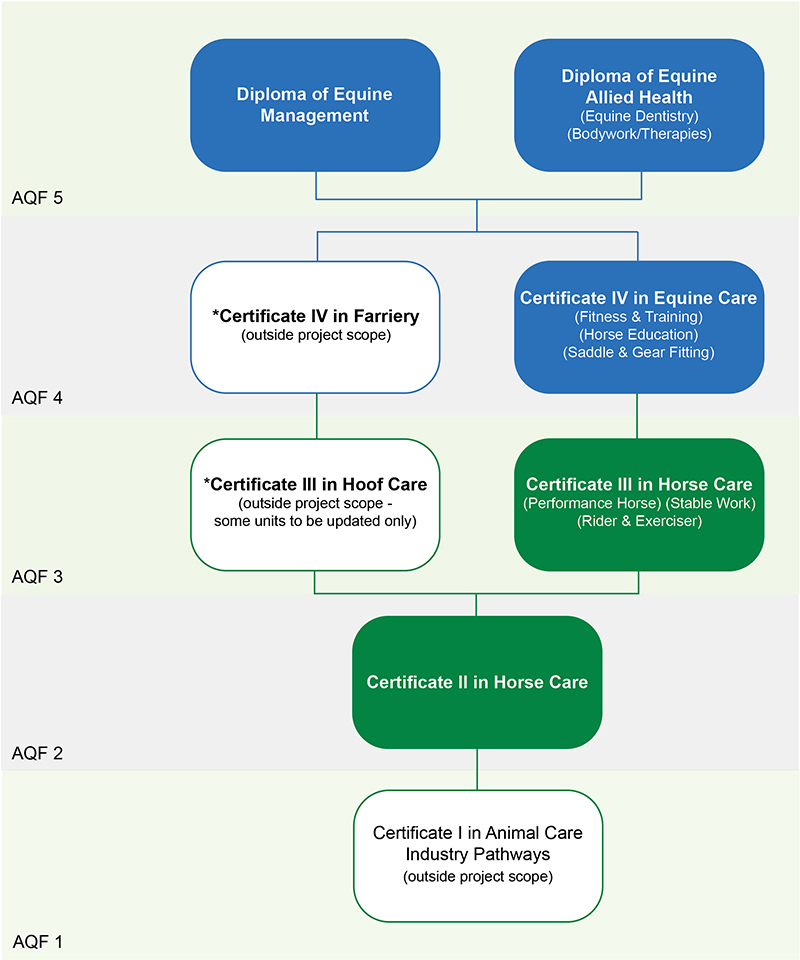
This project will review Certificate II in Horse Care, Certificate III in Performance Horse, Certificate IV in Equine Dentistry and Diploma of Performance Horse Management and relevant units.The Certificate III in Equine Hoof Care will also be updated as it contains some of the units that will be reviewed. However, the qualification itself is not being reviewed at this time.
Register your interest in the project
Subscribe to the Skills Impact newsletter to keep informed about project updates. Make sure to select ‘Animal Care and Management’ as your industry of interest on the subscription form.
August – October 2020
Initial scopingNovember 2020 – January 2021
Development of draft qualifications, skill sets and unitsMid-February 2021
Drafts available for broad consultationMay 2021
Validation of final draftsJune 2021
Finalisation of Training Package componentsJuly – August 2021
Independent Quality Assurance, and Edit and Equity review of Training Package componentsSeptember 2021
IRC consideration for sign-off and submission for endorsement
Industry Skill Standards Development Manager and Strategic Training Package Review Specialist, Skills Impact
Opportunities for stakeholder input
Stakeholder input is appreciated throughout the duration of this project. The documents will be drafted in consultation with Subject Matter Experts and their networks. Opportunities to provide targeted feedback will occur when the draft materials are made available in February 2021, and again for validation of final drafts in May 2021. However, your feedback is welcomed at any time, and will help us in drafting the qualifications, skill set and units. It is important that training provides a skilled and flexible workforce for the future. The qualifications, skill sets and units need to reflect real work experience. So if you work in the sector, Skills Impact welcomes your input and help. Please feel free to register your interest for project updates and consultation opportunities by following the newsletter subscription link below. Alternatively, please feel free to contact the project manager, Lucinda O’Brien on 03 9321 3526 or [email protected].
Stakeholder Consultation Process
A list of key stakeholder organisations has been identified for this project. Skills Impact will ensure contact is made with each of these organisations during the development of this project to seek their involvement and their views on the draft qualifications, skill sets and units.If you are aware of an organisation that you think should be involved, please contact the project team to ensure they are contacted by us.Of course, all and any interested industry participants are encouraged to engage in the consultation of this project, when the draft qualifications, skill sets and units are available for feedback via this webpage and workshops that take place around Australia. Consultation is not limited to the organisations on this list. This list simply helps us to identify those organisations that, because of their industry role, size or specialty, are likely to have a key interest in the development and outcomes of this project.
D
There are many and varied career paths in the horse care sector, with each playing an important role in promoting and maintaining the welfare of horses. This project is looking at the skills standards across a range of job roles from a stablehand or a groom, to a saddle fitter, nutritionist, massage therapist or those practicing equine dentistry. Particular skills are required to make sure a horse’s teeth, body and hooves are healthy, that the equipment used is appropriate and safe, and that all their basic needs are met. Across all these roles, skills in safety are an integral part of providing care to horses, protecting equine professionals and those around them in all their interactions with horses. The need for this project was identified out of a survey Skills Impact undertook in 2019, to explore the types of horse care services used, who is carrying out this work and how, and the skills and knowledge workers and owners possess and develop.
Work has commenced to review and redevelop the existing qualifications and units of competency for horse care, performance horse and equine services (dentistry, saddle and equipment fitting, body work and early education). During November 2020, Skills Impact is meeting with Subject Matter Experts from these industry sectors from across Australia to undertake a workforce functional analysis to identify current job roles and work functions and any gaps in the skills standards.
Consultation Workshops – Registrations Open!
A number of consultation webinars have been scheduled to give stakeholders an opportunity to discuss the draft skills standards with the Skills Impact team. At these sessions, the team will provide background on the project and its objectives and present draft documents to discuss whether the proposed changes meet the needs of industry. You will also be walked through how to use the Skills Impact Online Feedback Hub to provide feedback on the drafts. Draft documents and supporting documentation will be available on the Skills Impact website from mid February to mid March 2020.Registrations for consultation workshops are now open. Please register by clicking the corresponding link.
Certificate II & III Webinars
These webinars will focus on addressing the skills and knowledge required for work activities undertaken by horse carer and handler roles (such as stable work, grooming, exercising and equine hoof care).Wednesday 17 February, 10am to 12pm AEDT – register hereThursday 18 February, 1pm to 3pm AEDT – register hereFriday 19 February, 10am to 12pm AEDT – register hereTuesday 23 February, 10am to 12pm AEDT – register here
Certificate IV & Diploma Webinars
These webinars will focus on addressing the skills and knowledge required for work activities undertaken by equine service providers (dentistry, saddle and equipment fitting, body work and early education) and equine establishment or team managers.Wednesday 17 February, 1pm to 3pm AEDT – register hereThursday 18 February, 10am to 12pm AEDT – register hereFriday 19 February, 1pm to 3pm AEDT – register hereMonday 22 February, 10am to 12pm AEDT – register here
Training Delivery Webinars
Webinar are also being held specifically for stakeholders interested in discussing training delivery and assessment of the draft skills standards.Certificate II and III – Monday 22 February, 1pm to 3pm AEDT – register hereCertificate IV & Diploma – Tuesday 23 February, 1pm to 3pm AEDT – register here
Register your interest in the project
Subscribe to the Skills Impact newsletter to keep informed about project updates and opportunities to provide input and feedback. Make sure to select ‘Animal Care and Management’ as your industry of interest.
A range of professionals require specialised skills in working to maintain the welfare of horses, including stablehands or grooms, saddle fitters, nutritionists, massage therapists and equine dentists. Unique expertise is required for each of these roles, to keep a horse’s teeth, body and hooves healthy, to make sure equipment used is appropriate and safe, and to check all of a horse’s basic needs are met. Across the industry foundational skills in safety are vital, protecting equine professionals and those around them in their interactions with horses.Consultation is taking place throughout this project to capture the types of horse care services available and the skills and knowledge required for them in nationally endorsed qualifications, skill sets and units.Thank you to everyone who provided feedback on the initial draft documents made available from 16 February - 16 March 2021 and on the additional changes to some of the qualifications, skill sets and units made available from 13 May - 10 June 2021.Your feedback is being considered by the Subject Matter Expert Working Group and where appropriate the Animal Care and Management Industry Reference Committee. Your feedback will inform further work on the final drafts, which are expected to be available for industry comment and validation in late June 2021. A summary of the feedback and how it was addressed in the final drafts will also be available.
Drafts Available 13 May - 10 June 2021
Feedback was sought on changes to the documents, including:
Changes to qualifications:
Creation of Diploma of Equine Allied Health as industry feedback indicated that these skills required expertise at a diploma level.
Updates to the Certificate IV in Equine Care to remove dentistry and massage job roles which are now included in the Diploma of Equine Allied Health.
Updates to the Certificate II and III in Horse Care and Certificate III in Equine Hoof Care to reflect changes to the unit ACMEQU2X12 Handle horses safely.
Creation of Transport Horses by Road Skill Set to capture the skills required for this specific job task. This skill set is designed for people who may not usually work with horses, but who need to load and unload them, ie: those working in transport or emergency services.
Separation of Element 4, 'load and unload horses', from ACMEQU2X12 Handle horses safely into its own unit. Feedback indicated that handling horses safely was an essential skill required before learning how to load and unload horses. It was also indicated that loading and unloading is a distinct skill and is needed only in some job roles.
Development of an equine rehabilitation program unit, as there was a skills gap in quality of care and program writing after therapy.
Creation of a new unit for working safely as an equine contractor, as industry indicated that there was no level 5 unit available for working independently in the industry, despite the high number of contractors involved in caring for horses and the need for skills in safety and biosecurity.
Updates to one unit for horse clipping services so that it meets industry needs.
Assessor requirements for riding units updated.
Some units recoded to level 5 to reflect their placement in the Diploma of Equine Allied Health.
Updates made to the Companion Volume User Guides (Safety in Equine Training & Equine Allied Heath) to align with the updated information in the units, and to reflect new practices and techniques.
Please click here to download the Summary of Feedback, Responses and Actions document, which provides a rundown of comments made about these components and how these informed the proposed changes.
Packaging rules amended.ACMNEW2X1 Load and unload horses added to Core, ACMEQU3X18 Transport horses by road moved to Electives.Additional units added to electives:
ACMGEN303 Assess the welfare status of an animal
SISOEQU014 Determine nutritional requirements for sport or recreational horses
This skill set describes the skills and knowledge to safely transport horses by road, including planning, loading, unloading and consideration of animal welfare requirements.
Element 4 'Load and unload horses' removed to include in separate unit. Updates to Performance Criteria, Performance Evidence, Knowledge Evidence, Assessment Conditions and mapping table.
The proposed the Assessor Requirements in the following three units have been updated since the release of the first draft of these units in March 2021.The proposed requirements include the assessor having a current first aid certificate; current, recognised qualification for instructing or coaching horse riding and handling skills; and at least three years’ experience. These coaching certification and experience requirements vary by unit, are explained more fully on page 59 of the draft User Guide: Safety in Equine Training.Skills Impact sought stakeholder feedback on the proposed Assessor Requirements in the units and related information in the User Guide (page 59). We also welcomed feedback and suggestions to improve the User Guide that will be published as part of the release of the updated Animal Care and Management Training Package (ACM Version 5.0). A consultation webinar took place give stakeholders an opportunity to discuss the proposed Assessor Requirements for the riding units and User Guide with the Skills Impact Team.Wednesday 26 May, 11am to 11:30 am AEST – register here
Unit code and name
Link
ACMEQU2X18 Perform horse riding skills at walk, trot and canter
The following units have been recoded to Australian Qualifications Framework (AQF) level 5, reflecting their placement in the Diploma of Equine Allied Health. They have had minor changes to titles, Application, Performance Criteria, Foundation Skills, Performance Evidence, Knowledge Evidence and Assessment Conditions.
Unit code and name
Link
ACMEQD5X1 Identify equine masticatory and oral function, conditions and health impacts
ACMEQU5X12 Relate equine anatomical and physiological features to equine health care requirements
Previously merged into revised unit ACMEQU4X20 Maintain and monitor horse health, separated back out to more accurately reflect the task undertaken in the workplace.
ACMEQU5X10 Work within an equine allied health provider framework
Previously ACMEQU4X13 Establish professional practices in equine service provision, redesigned with some content removed and placed into ACMNEW5X11 Work safely in providing equine services as a contractor. Performance Evidence & Knowledge Evidence revised to reflect changes to Performance Criteria.Added 'writing' to Foundation Skills.
ACMNEW5X11 Work safely in providing equine services as a contractor
Created to address the lack of Australian Qualification Framework level 5 units for contractors within the horse care industry.Draft Performance Criteria from ACMEQU4X13 Establish professional practices in equine service provision removed to create new unit with greater emphasis on safety and biosecurity for contractors.
Two Companion Volumes are referenced in relevant units of competency to assist with delivery and assessment:
Companion Volume: User Guide: Safety in Equine Training provides advice and sample templates to assist assessors with the risk assessments that should be undertaken to help ensure the safety of all involved in the assessment.
Companion Volume: User Guide: Equine Allied Health provides delivery and assessment information tailored for equine dental technicians and detailed guidelines relating to anatomical requirements and industry expectations.
Unit code and name
Proposed changes or rationale
Link
Companion Volume: User Guide: Safety in Equine Training
Updated to reflect changes made to units and in the industry.Seeking specific feedback on riding units assessor requirements.
The draft documents can be downloaded in Microsoft Word format by clicking here.
Drafts Available 16 February - 16 March 2021
The draft qualifications, skill sets and units were reviewed and updated to strengthen safety and welfare, remove duplication and incorporate current skills and knowledge required by industry.Feedback was invited on whether the draft qualifications, skill sets and units reflect the current skills standards and practices of industry, and whether job functions are accurately described. In particular feedback was sought on the preferred terminology between equine and horse within the units, skill sets and qualifications. At present, equine is used to describe different education methodologies (behaviour, cognition, learning theory etc). Horse is used when describing application of the education methodologies to individual horse. For more information on the proposed changes, please
download the Summary of Technical Changes.Many of the qualifications, skill sets and units within this project have had low enrolments in recent years and have been flagged for deletion from the national register. A survey conducted in 2019 provided some insights into why these skills standards have not been used and how they could be improved. Of the 546 people that responded, there was a clear indication that there could be a better way to incorporate safety and care skills in current qualifications, skills set and units, so that it is consolidated throughout the learning journey as a key element of this work. Those surveyed included horse care workers and those that use their services. The survey also indicated that some skills areas are not currently defined by nationally endorsed skills standards and that a redesign of current skills standards could provide better access and support more flexible career pathways.The Industry Reference Committee and Subject Matter Expert Working Group have considered this feedback and support the need for national skills standards and training for the majority of these skills, especially in relation to safety, animal behaviour and animal welfare. Therefore the qualifications, skill sets and units were revised to encourage further training. Six units were identified as not required by industry and were proposed for deletion. One qualification, the Diploma of Performance Horse Management, was identified as describing skills that are out of date and in need of revision. It was revised to incorporate the management skills required across numerous equine establishments so it could be used more broadly by industry, and has been retitled to the Diploma of Equine Management.
Total number of units required to achieve the qualification decreased from 14 to 12Changes to packaging rules, core and elective unitsRiding specialisation removed
Previously ACM50417 Diploma of Performance Horse. This qualification is proposed for deletion due to lack of enrolments. However, industry feedback to date has suggested the qualification would be of use if redesigned to cover a broader section of the industry. Advice is sought on the proposed new title and on whether the redesign and retention of the qualification is an appropriate approach.For more information about lack of enrolments and to provide detailed feedback on solutions,
download the feedback sheet.
ACMSSNEW000X1 Prepare To Work Safely Around Horses Skill Set
This skill set describes the skills and knowledge to understand and interpret horse behaviour and body language in order to minimise risks to self, others and horses when working around horses. It does not involve direct handling of horses.
ACMSSNEW000X2 Horse Groom Functions Coordinator Skill Set
This skill set provides skilled and experienced horse grooms and stable hands with the skills and knowledge required to coordinate horse care tasks and workers in an equine workplace.
Unit redesigned to include greater knowledge and application of horse behaviour, and skills related to handling horses safely for a broader range tasks and contexts.
This unit of competency describes the skills and knowledge required to plan, support and implement work health and safety processes in an equine workplace, including hazard identification, risk assessment and control. It also includes responding to emergency situations.
ACMEQU4X13 Establish professional practices in equine service provision
Original unit was for equine dentistry - ACMEQD401 Work within an equine dental service provision frameworkUnit has been reworked and updated - elements and Performance Criteria reworded to:
make the unit broader and applicable to equine service practitioners i.e. not specific to equine dentistry
address safe handling of horses so as to remove the need for prerequisites in some units i.e. content more specific to working in close proximity to horses
provide greater focus on biosecurity and hygiene and record keeping
Element 3 Removes the need for former prerequisites:
ACMEQD4X7 Conduct assessment of equine masticatory system and plan dental treatment
Seeking specific feedback on Performance Criteria 1.3, Performance Criteria 2.4 and level of detail of Knowledge Evidence and if it could be moved to Equine Dentistry User Guide.
ACMEQD4X8 Perform equine dental treatment and oral care using manual and/or motorised instrumentation
Seeking specific feedback on Performance Criteria 3.4 & Performance Criteria 4.9 and level of detail of Knowledge Evidence and if it could be moved to Equine Dentistry User Guide.
As described at the top of this webpage, these units are proposed for deletion. Feedback was invited and collected through a survey and email.
Unit code and name
Rationale
Link
ACMEQU101 Approach and catch horses
This unit has no enrolments, is not listed in any qualifications and is not on scope with any RTOs. The unit also duplicates the outcomes of RGRPSH101 Catch and handle quiet horses under supervision.
There have been no enrolments in this units and industry has advised the outcomes of this unit can be achieved by enrolling in ACMMER405 Provide advice on livestock products.
The draft qualifications, skill sets and units have been drafted in consultation with Subject Matter Experts. They have considered feedback that was received out of Workforce Functional Analysis workshops from October 2020 through to January 2021. People working directly across the horse industry participated and provided information on the skills and knowledge required for job roles and tasks. Thank you to those who provided feedback during these meetings.Feedback on the draft qualifications, skill sets and units of competency was then invited from the broader industry and the drafts were available on this webpage for feedback between 16 February and 16 March 2021. Feedback highlighted the need to make further changes to some of the qualifications, skill sets and units. As a result, the qualifications, a skill set and some units were made available for an additional round of feedback from 13 May – 10 June 2021. During these times, feedback was collected through the online feedback hub, consultation webinars and email. The drafts, including any comments made on the feedback hub, are available to view above.All feedback is being considered by the Subject Matter Expert Working Group and where appropriate the Animal Care and Management Industry Reference Committee. Feedback will inform further work on the final drafts, which are expected to be available for industry comment and validation in late June 2021. A summary of the feedback and how it was addressed in the final drafts will also be available.
Consultation webinars
A number of consultation webinars were held to give stakeholders an opportunity to discuss the draft skills standards with the Skills Impact team. At these sessions, the team provided background on the project and its objectives and presented draft documents to discuss whether the proposed changes meet the needs of industry. They also walked through how to use the Skills Impact online Feedback Hub to provide feedback on the drafts. Webinars to discuss training delivery of the qualifications were also held, covering the same content, but with time allocated to discussions around delivery. Below are recordings of three of the webinars for anyone who was unable to attend. Please note the recording has been edited to remove comments by participants, to support their privacy.
Certificate II & III WebinarsThese webinars focused on addressing the skills and knowledge required for work activities undertaken by horse carer and handler roles (such as stable work, grooming, exercising and equine hoof care).A recording of one of the certificate II & III webinars is available below.
Certificate IV & Diploma WebinarsThese webinars focused on addressing the skills and knowledge required for work activities undertaken by equine service providers (dentistry, saddle and equipment fitting, body work and early education) and equine establishment or team managers.A recording of one of the certificate IV & diploma webinars is available below.
Riding Units Assessor Requirements
An online consultation webinar was held on 26 May 2021 to give stakeholders an opportunity to discuss the proposed Assessor Requirements for the riding units and User Guide with the Skills Impact team. A recording of this webinar is available below.
Register your interest in the project
Subscribe to the Skills Impact newsletter to keep informed about project updates and opportunities to provide input and feedback. Make sure to select ‘Animal Care and Management’ as your industry of interest.
Caring for and maintaining the welfare of horses takes a whole team of professionals with specialised skills. Unique expertise is required to fit saddles, advise on nutrition and carry out the day to day care of horses. Professionals with these skills are needed to keep a horse healthy, to make sure equipment used is appropriate and safe, and to check the horse’s basic needs are met. Foundational skills in safety are vital across the industry, protecting equine professionals and those around them in their interactions with horses.Thank you to everyone who provided feedback on the final draft qualifications, skill sets and units of competency. You can still view the documents and any comments made below.All validation comments are being considered by the Subject Matter Expert Working Group, and where appropriate the Animal Care and Management Industry Reference Committee, to produce the final drafts that will move through to the Finalisation stage of the project.This project is looking at the skills standards across a range job roles and activities involved in maintaining the welfare of horses. Validation and comments were collected on a broad range of horse care skills standards between 22 June and 6 July 2021. Feedback for the draft skills standards that related to equine dentistry and massage was significant and required additional time to analyse. They were available for validation between 13 and 27 July 2021.
Equine Dentistry and Massage
The following drafts were available for validation and comment between 13 and 27 July 2021. Thank you to those who provided feedback on these final drafts. You can still view the documents and any comments made below.
Summary of feedback and key changes
The draft Diploma of Equine Allied Health attracted a lot of feedback that has required additional work to distil and consider. The following issues were raised as part of the 'Drafts Available stage' in May and June 2021. This feedback was considered by subject matter experts and through discussions with the Animal Care and Management IRC to revise the final drafts.Diploma of Equine Allied HealthQuestions were raised as to whether the training should be at a diploma level. Analysis has demonstrated that the volume and content of learning has increased for equine dental technicians to address the expanding knowledge of animal welfare considerations. It appears to be appropriate that any other allied health occupations should have starting points at the same level, given the importance of critical welfare considerations.Knowledge of sedation in equine dentistryQuestions were raised as to whether the level of knowledge related to sedation is necessary given that equine dental technicians are not required to administer sedation. Further consideration has resulted in a recommendation that knowledge of sedation at the described level is important to ensure the avoidance of detrimental animal welfare impacts.Questions were raised as to whether there should be room to include administration of sedation now or in the future in the qualification. This idea has been rejected and the view remains that such training is outside the scope of this project and would need to be provided by veterinarians outside of the VET system. This is a serious issue that should be left fully in the hands of the relevant veterinary authorities and professional member bodies, and not decided as part of a project within VET.Use of technology in equine dentistry – motorised tools, power tools, mechanical floatingFeedback received indicated opposition from some veterinarians and other contributors as to the inclusion of these skills, while other veterinarians and contributors provided support for inclusion. The drafts for validation include training in the use of modern technology in the application of specific activities that fall within the scope of an equine dental technician. Defining the current position of use of technology is difficult in most occupations, especially health-related occupations where surgical procedures are now being carried out with the use of automation. International trends indicate a shift towards the use of technology by equine dental technicians and evidence is that this is happening already in Australia.Further feedback will be considered, particularly feedback which distinguishes specific procedures that could or could not be carried out by equine dental technicians using technology. This is already incorporated into the draft for validation of ACMEQD5X3 Perform equine dental treatment and oral care using appropriate instrumentation.Other feedback receivedFeedback was received questioning whether there is sufficient demand for the equine dentistry element of the qualification, given low enrolment numbers in the current qualification and the increase in veterinary science graduates. This has previously been considered and research was undertaken. One of the drivers of this project was information that the current qualification was not attracting enrolments due to lack of appropriate content and the competition from international offerings. As part of normal procedures for all updated training products, Skills Impact is seeking evidence related to potential enrolments for the qualification.Feedback was received from veterinarians regarding the potential regulation of equine allied health occupations. This is not within the authority of the IRC and training cannot be mandated through the VET system. Regulated or protected occupations can only be established through legislative or regulatory processes. The establishment of appropriate levels of formally recognised qualifications is often an important consideration when examining potential for future regulation or protection.Feedback that has been received that is not directly relevant to the content and standards of the qualification has been reviewed, and no action can be taken on this feedback by the IRC, Skills Impact or the subject matter expert working group.A number of members of Equine Veterinarians Australia have participated in the process, with some providing a pro forma response. The association has also presented feedback on behalf of its members. A response has been sent to the EVA and this response can be reviewed here.A description of how feedback has been considered and applied in these final drafts can be downloaded by clicking on the following button.
ACMEQD5X2 Conduct assessment of equine masticatory system and plan dental treatment
Minor edits to Application.Performance Criteria, Performance Evidence and Assessment Criteria references to veterinarians maintained as advised by Industry Reference Committee, 'carer' changed to 'agent' throughout unit.Minor changes to Performance Criteria’s 2.4, 3.1, 4.1, 5.3, 6.2 and 6.3.Mapping information updated.Minor edits to Performance Evidence and Knowledge Evidence.
ACMEQD5X3 Perform equine dental treatment and oral care using appropriate instrumentation
Performance Criteria, Performance Evidence and Assessment Criteria references to veterinarians maintained as advised by Industry Reference Committee, 'carer' changed to 'agent' throughout unit.Minor changes to Performance Criteria’s 3.6, 4.2, 4.6 and 4.7.
Mapping information updated.Minor edits to Performance Evidence and Knowledge Evidence.
ACMEQU5X12 Relate equine anatomical and physiological features to equine health care requirements
Horses changed to equines (except reference to legislation) throughout unit.New Performance Criteria 3.1 added and associated Knowledge Evidence points.Mapping table updated.Assessment Requirement volume/frequency changed from 2 to 6 equines.
The Companion Volumes are referenced in relevant units of competency to assist with delivery and assessment. The Companion Volume: User Guide: Equine Allied Health provides delivery and assessment information tailored for equine dental technicians and detailed guidelines relating to anatomical requirements and industry expectations.
Document name
Proposed changes
Link
Companion Volume: User Guide: Equine Allied Health
Minor updates to technical language throughout document.References to veterinarians maintained as advised by the Industry Reference Committee.
The draft document can be downloaded in Microsoft Word format by clicking here.
Horse Care Qualifications & Skills Standards
The following drafts were available for validation and comment between 22 June and 6 July 2021. Thank you to those who provided feedback on these final drafts. You can still view the documents and any comments made below.
Summary of feedback and key changes
The final drafts incorporated feedback that was received on the initial drafts that were made available between 16 February and 16 March, and from 13 May to 10 June 2021, under the ‘Drafts Available’ stage. During this time, feedback was collected through the online feedback hub, national webinars, by phone call and email. This feedback was considered by subject matter experts and through discussions with the Animal Care and Management IRC to revise the final drafts. Key changes to the documents included:
Five qualifications were revised with:
Updates to the Certificate IV in Equine Care to remove dentistry and massage job roles
Updates to the Certificate II and III in Horse Care and Certificate III in Equine Hoof Care to reflect changes to units
Entry requirements updated for the Diploma of Equine Management and Certificate IV in Equine Care.
Three skill sets were reviewed and three developed, to support safety skills across a range of job tasks as well as skills in specific areas such as transporting horses, coordinating horse care tasks and workers in an equine workplace.
Forty-five units were revised, including merging 20 units into 13, and updates to:
strengthen safety standards throughout
remove duplication within the documents
reorder content within the documents for clarity
update terminology
revise and improve flexibility of delivery
update language to better reflect Australian Qualification Framework (AQF) alignment
include skills for referring to other professionals where work is outside scope
update performance evidence volume and frequency to better reflect industry requirements.
Six units were developed to address skills needs for specific expertise needed across the horse care sector.
Six units were proposed for deletion as they have no enrolments or are no longer required by industry.
A description of how feedback has been considered and applied in these final drafts can be downloaded by clicking on the following button.
Qualification description edited to remove duplication and statement regarding the pre-apprenticeship pathway.Packaging rules changed to reduce core from 6 to 5, and increase electives required from 7 to 8.ACMEQU2X21 Manage personal health and fitness for working with horses has been moved from core to the electives.ACMEQU2X14 Prepare to work safely around horses has been removed from the electives and will now be added to ACM20121 Certificate II in Animal Care.Title of Elective Group A has changed.Five additional units listed in Elective Group B.
Packaging rules changed to reduce core from 9 to 8, and increase electives required from 9 to 10.ACMEQU4X12 Interpret and address horse behaviour and welfare has been moved from core to the electives.
Minor changes to Performance Criteria 2.2, 2.4, 3.3 and 3.5 for clarity.Performance Evidence related to nose and skin twitches has been revised. Cleaning of horse hooves and verbal reporting of incident removed.Minor changes in the Knowledge Evidence for clarity and to remove knowledge of personal immunisation, and traffic and safety signage.
ACMEQU2X13 Follow safe work practices in equine industries
Minor changes to Performance Criteria including merging 3.4 and 3.5. Minor changes to Performance Evidence and Knowledge Evidence for clarity and removal of unnecessary duplication. Minor changes to the Assessment Conditions for clarity and to advise the emergency scenarios in the Performance Evidence can be simulated.
Minor edits to Performance Criteria’s 1.1, 1.4 and Element 3. Horse identification added to the Performance Evidence and minor revision to reporting requirements.Basic hazard identification and risk assessment added to the Knowledge Evidence.
Minor change to Application to better reflect work outcomes. Performance Criteria 1.7 removed, and order of updated to better reflect workflow. Minor changes in the Performance Evidence for clarity and reduction of tasks required. Awareness of phenomena that can spook horses, and control of visitor’s behaviour have been added to the Knowledge Evidence. Assessment Conditions revised to include assessment in an environment that represents workplace conditions and advise the fire emergency scenario in the Performance Evidence can be simulated.
Element 2 and Performance Criteria revised. Minor revisions to Performance Criteria 3.2 and 4.8 for clarity. Performance Evidence revised for clarity. Knowledge Evidence revised for clarity and to include hazard identification, risk assessment, risk control and risk reporting responsibility, awareness of prohibited substances, ailments that require immediate reporting and repetitive strain injury. Assessment Condition equipment and materials.
New Performance Criteria 1.6 added, 1.7 revised to make it optional. Edits made to other Performance Criteria’s for clarity and consistency across other units reflecting AQF level 2 outcomes. Performance Evidence and Knowledge Evidence revised.
ACMEQU2X21 Manage personal health and fitness for working with horses
Application revised to better reflect entry level workers in equine workplaces.Minor changes to Performance Criteria to better reflect the AQF level of the unit and allow flexibility across workplaces.Implementation of at least two fitness or health improvement actions added to Performance Evidence.Confidentiality requirements added to the Knowledge Evidence, and zonoses removed.Other minor changes to focus the assessment on the worker's own role.
Unit application revised to make it clearer that the worker is implementing an existing horse health care program, and the unit covers treatment of illness and injuries with advice from professionals. Performance Criteria’s 2.2, 3.2 and 3.2 deleted to remove duplication New Performance Criteria’s 4.1 and 6.4 added. Performance Evidence and Knowledge Evidence revised.
Application revised to better reflect the work outcomes. Minor change to Performance Criteria’s and Element 3 for clarity. Minor changes to Performance Evidence for clarity and to provide flexibility on some tasks. Knowledge Evidence revised for clarity and to add waste disposal, cleaning and sanitising of equipment to prevent infection control, awareness of prohibited substances in food and medications, and flyveils and other protective equipment.
Performance Criteria’s 2.4 and 3.4 removed, 2.2 revised for clarity. Performance Evidence revised, requirements to treat specific ailments and conditions has been removed, and replaced with identification and explanation of treatments for six of the more common/simple hoof ailments and conditions. Knowledge Evidence reduced to reflect six of the more common/simple ailments and conditions. Assessment Conditions revised to allow emergency shoe removal and hoof trims to performed on cadaver horse leg.
Minor edits to the Application, Performance Criteria’s 2.1, PC 3.2 and Unit Mapping comments for clarity.Cleaning and tidying horse section of transport vehicle added to the Performance Evidence.Minor changes to Knowledge Evidence for clarity and to remove duplication.
Minor changes to Performance Criteria’s 2.4 and 2.5 for clarity. Performance Evidence has been revised and the requirement to transport a group of three horses has been reduced to two horses, the cross border transport has been removed and replaced with completion of documentation and other preparation required for cross boarder horse transport.
ACMEQU3X11 Prepare horses for presentation at competition, sale or event
Updated title. Elements and Performance Criteria updated for clarity, flexibility, removing duplication and unrequired tasks. Mapping comments updated. Performance Evidence revised to reduce the type of events from two to one, remove horse categories and for clarity. Knowledge Evidence revised for clarity and to include knowledge of breed standard or competition requirements for horse feature enhancements, hoof dressings and quarter marks.
ACMEQU3X12 Prepare and care for horses to perform at events
Elements and Performance Criteria updated for clarity, removing duplication and added new 1.3, 2.1 and 5.1. Mapping comments updated. Performance Evidence revised to reduce the type of events from two to one, remove horse categories and for clarity. Knowledge Evidence revised for clarity and addition of additional items related to biosecurity, traceability, trimming horses, accessing information at event sites and site cleaning requirements. Assessment Conditions physical conditions revised.
Minor edits to Performance Criteria’s for clarity. Performance Evidence revised and lungeing exercise duration reduced from 15 to 10 minutes, lungeing environment updated for flexibility. Knowledge Evidence revised to increase clarity and to include reporting and controlling health and safety risks. Minor edits Assessment Conditions for clarity.
Unit recoded with an AQF level 3 identifier. Application changed, Elements 2 and 3 merged. Unit mapping changed to Not equivalent. Performance Evidence revised to allow choice of swimming or exercising horses using mechanical equipment, and durations of exercise reduced.Assessment Conditions updated to reflect choices available in Performance Evidence.
Specific assessor requirements have been removed from the Assessment Conditions of the three revised riding units. This decision was made after consultation with many stakeholders, consideration of this feedback, and advice from a Training Package Quality Assurance panel member and from the subject matter expert working group and members of the Animal Care and Management IRC.The project consultation has shown there is a strong desire by many stakeholders in the industry for an assessor to hold a specific unit or skill set in order to safely assess someone undertaking these units, to go beyond the Standards for RTOs 2015. However, there is no nationally accredited or agreed certification standard (i.e., a unit or skill set) that can be added to the Assessment Conditions.Skills Impact will undertake research to determine the feasibility of creating a 'Horse Riding Trainer and Assessor' unit or skill set (probably reflecting AQF level 4) as part of a future project, and when the unit or skill set is endorsed, seek to include it in the riding units as specific assessor requirements. To provide comment or expression of interest in this please email [email protected].
Unit code and name
Proposed changes or rationale
Link
ACMEQU2X18 Perform horse riding skills at walk, trot and canter
Minor edit to Performance Criteria 2.5 to remove group riding.Numeracy added to the Foundation Skills.Minor edit to Performance Evidence to remove 'accessory gear'.Minor edit to Assessment Conditions to clarify and strengthen RTO on risk assessment, risk controls and horse matching.
ACMEQU2X19 Develop riding skills for exercising horses
Minor edit to Application and Performance Criteria 1.5 for clarity.Numeracy added to the Foundation Skills.Minor edits to Performance Evidence to correct grammar and increase clarity.Minor edits to Knowledge Evidence for clarity.Minor edit to Assessment Conditions to clarify and strengthen RTO on risk assessment, risk controls and horse matching.
Minor change to Application for clarity.Foundation Skills revised.Minor changes made to the Performance Evidence for clarity and to remove duplication with prerequisite units.Advice on risk assessment, risk controls and horse matching added to the Assessment Conditions.
New Performance Criteria 3.4. Writing Foundation Skills updated. Knowledge Evidence on anatomical and physiological structures and functions and communication added.
ACMEQU4X22 Evaluate equine service or therapy provision
Title updated with ‘therapies’ to replace ‘treatment’ throughout unit. Focus of unit to cover both 'therapies' and 'services'. Performance Criteria updated. Foundation Skills updated. Knowledge Evidence added to address new Performance Criteria.
Performance Criteria updated. Writing Foundation Skills added. Performance Evidence and Knowledge Evidence updated and added and to address new Performance Criteria.
ACMNEW4X2 Provide saddle fitting and adjustment services
Performance Criteria updated. Writing Foundation Skills added. Performance Evidence and Knowledge Evidence updated and added and to address new Performance Criteria.
ACMEQU4X11 Evaluate horse education methodologies and individual programs
Performance Criteria 2.2 Research added to align with Performance Evidence. Writing Foundation Skills added.Performance Evidence volume/frequency increased from 2 to 3 horses.
ACMEQU4X15 Relate musculoskeletal system to horse conformation and movement
Performance Criteria’s updated 2.3, 3.2 & 3.3 (revised wording), new 3.6 & 3.7. Writing Foundation Skills added . Minor updates to Performance Evidence, Knowledge Evidence and Assessment Conditions for clarity and application to all vocational groups.
This unit has no enrolments, is not listed in any qualifications and is not on scope with any RTOs. The unit also duplicates the outcomes of RGRPSH101 Catch and handle quiet horses under supervision.
Companion Volumes assist industry and registered training providers (RTOs) to deliver and assess the units, qualifications and skill sets within a training package.A Companion Volume User Guide: Safety in Equine Training is being drafted to provide advice and sample templates to assist assessors with the risk assessments that should be undertaken to help ensure the safety of all involved in the assessment.
Unit code and name
Proposed changes or rationale
Link
Companion Volume: User Guide: Safety in Equine Training
Updated to reflect current industry requirement and changes in units.
The draft document can be downloaded in Microsoft Word format by clicking here.
Register your interest in the project
Subscribe to the Skills Impact newsletter to keep informed about project updates and opportunities to provide input and feedback. Make sure to select ‘Animal Care and Management’ as your industry of interest.
Horse owners rely on a range of professionals with expert skills to care for and maintain horse welfare. Unique expertise is required to keep a horse's body functioning well, to make sure equipment used is appropriate and safe, and to make sure basic needs are being met. Safety skills are vital across the industry, protecting equine professionals and those around them in their interactions with horses. As there are so many individuals involved in the care of horses, it is important that all the diverse skills required are captured in nationally endorsed skills standards. This will help support consistency in how services are provided.Thanks to the contributions of everyone involved in this project, the skills standards for a range of horse care professions were captured in updated qualifications, skill sets and units of competency. Overall, this review focused on strengthening safety skills across all environments in which people interact with horses, capturing the full breadth of skills required for those who work alongside horses either directly or indirectly, and supporting flexibility of delivery and career pathways throughout equine related qualifications.
The qualifications were updated to promote movement between schools and VET and support learners from entry level positions through to more niche expert roles. Skill sets were updated and developed to support skills for emergency shoe replacement, coordination of horse care tasks and workers, and safety skills across a range of environments, including while instructing learners, while handling horses, while transporting horses, and working around horses. Units were revised and developed to strengthen safety skills and ensure flexibility of use across different job roles involving horses. Some units were merged to better reflect work tasks and some were deleted as they were no longer required by industry.The updated qualification and units were published on the national training register (training.gov.au) within the ACM Animal Care and Management Training Package on 18 February 2022.
…skills in safe horse handling are an integral part of our institution here. Volunteers, riders, carers, parents are provided with training in varying levels depending upon their interactions with horses at our establishment.I believe that the standards developed have reinforced safety and created clear job pathways for people within the horse industry. I look forward to teaching and working with individuals with the updated standards for horse care.Jacqui Moon, CEO, Claremont Therapeutic Riding Centre
The focus on safety for handler, bystanders and horse has been tailored to ensure everyone moving through any qualification has these skills prior to more intensive job roles. This ensures the safety of all people involved in and around horses and gives confidence to other professionals, such as vets and farriers, when engaged by Qualified equine person. The Qualifications also allows clear progression in knowledge and skills through the different certificate levels, and again are tailored to the job roles within the equine industry.Lisa Wallace, Lecturer, Central Regional TAFE WA
Summary of feedback and key changes
A Subject Matter Expert (SME) working group containing recognised industry experts from around the country helped develop the draft skills standards. The drafts were then made available on this website for broad industry feedback as part of the ‘Drafts Available’ stage from 16 February to 16 March 2021. This feedback indicated the need for additional changes to some of the qualifications, skill sets and units, which were made available for further feedback from 13 May to 10 June 2021. Comments made during these two stages of feedback were used to develop the final drafts that were made available for ‘Validation’ from 22 June to 6 July 2021. Feedback for the draft skills standards that related to equine dentistry and massage was significant and required additional time to analyse, so these drafts were available for validation between 13 and 27 July 2021. Feedback on the drafts was collected through the online feedback hub, national webinars, by phone call and email.This project included key horse care practitioner qualifications that cover a number of diverse industry sectors. Every effort was made to inform as many stakeholders as possible (including regional, rural and remote stakeholders) and to explain the implications of any changes made.As a result of feedback collected throughout the project, the following key changes were made to the drafts:
Six qualifications across the horse care sector were updated to better support career pathways.
The Certificate II and III Horse Care qualifications were revised to create distinct and clear pathways from the entry level horse care workers to broadly skilled and autonomous horse care practitioners, such as stable hands, grooms and riders. The two qualifications have some units in common, that will provide some credit for entry level workers that seek to undertake the Certificate III.
The Certificate IV in Equine Care was created to provide a pathway in equine care, with occupational elective groups covering technical skills for a range of niche occupations.
The Diploma of Equine Management was updated so that is has a broader application than the previous Diploma of Performance Horse Management, comprising new and revised units that provide a general qualification or options to focus on a specific technical area by selecting electives in horse, farm, stud or business management.
The Diploma of Equine Allied Health was restructured with a common core and elective groupings/specialisations, potentially enabling other allied health specialisations to be added in the future without the need for an additional qualification to be developed.
Three skill sets were revised to incorporate changes to the units they contain, with some given updated titles.
Three skill sets were developed to support skills for working safely around horses, for performing horse groom functions and for transporting horses by road. These support crucial skills for working alongside horses safely in a range of conditions.
Forty one units were reviewed and updated, including the following updates:
Language within the units was updated to better reflect current terminology and Australian Qualification Framework (AQF) alignment.
Skills for referring to other professionals where work is outside scope were included in units where appropriate.
Updates were made to improve flexibility of delivery.
Performance evidence volume and frequency were reviewed to better reflect industry requirements.
All reviewed existing units of competency have been coded as EQU (equine) and revised to ensure they are not sector specific or limited to performance horses, enabling them to be imported across a range of sectors. A notable exception to this are the three equine dental units, coded EQD.
The revised ACMEQU212 Handle horses safely has been streamlined to make it even more suitable for use as prerequisite in horse related sectors in the Animal Care and Management Training Package and other training packages.
Safety units have been reviewed and developed to cover the needs of people on equine work sites from visitors that do not handle horses all the way through to highly skilled horse practitioners who may operate as contractors or as part of a team. In addition, specific safety and welfare knowledge and skills have been updated or added in each of the revised ACM equine units where required.
Specific assessor requirements for units instructing riding skills have been revised to strengthen the responsibility of RTOs and/or Assessors to undertake appropriate risk assessment and control to ensure the safety of all involved in assessing the unit, including matching horses to the riders being assessed.
Best use has been made of cross-industry and cross-sector units to prevent duplication of units, for example units from several other training packages have been included in the core and elective bank of the qualifications including units from the AHC, BSB, RGR and SIS Training Packages.
Twenty units of competency have been merged to become 13 to remove duplication.
Nine units were developed to address skills needs for specific expertise needed across the horse care sector.
Six units were deleted, as feedback indicated they were no longer needed by industry.
A description of how feedback has been considered and applied after the ‘Drafts Available’ stage can be downloaded below.
The final draft skill sets and units of competency were approved for endorsement by the Australian Industry and Skills Committee (read the communique) and State and Territory Ministers. All documents have undergone an edit, equity and independent quality assurance process, to ensure they are of high quality and comply with the Standards for Training Packages 2012, the Training Package Products Policy and the Training Package Development and Endorsement Process Policy. They have also been considered by the State/Territory Training Authorities (STAs/TTAs). A Case for Endorsement was submitted alongside the draft units, including a rationale of why these changes are needed and evidence of industry support.Please find below links to the final documents that are published on the national training register.
Download the Case for EndorsementCompanion Volume Implementation GuidesA Companion Volume Implementation Guide is being produced to assist industry and registered training providers (RTOs) deliver the units of competency and skill sets. It contains key information to help trainers adapt to any new changes, as well as additional information about the impacts of regulation and licensing implications and workplace health and safety on their training.
Download Part 1: Overview and Implementation
Download Part 2: Component DetailsTwo comprehensive user guides are also being updated to provide support for training providers to improve their delivery and outline industry’s expectation about training delivery:
Download User Guide: Equine Allied Health. This guide provides delivery and assessment information tailored for equine dental technicians and detailed guidelines relating to anatomical requirements and industry expectations.
Download User Guide: Safety in Equine Training. This guide provides advice and sample templates to assist assessors with the risk assessments that should be undertaken to help ensure the safety of all involved in the assessment. It has also been updated to include:
Manual for the Delivery of Horse Industry Training. This manual was developed by TAFE NSW to accompany the Australian Horse Industry Council Code of Practice for the Horse Industry, to promote safety and consistency of delivery of educational programs that require interactions with horses. This resource provides a range of advice to address the risks associated with handling, driving and riding horses to ensure that best practice is used by those delivering programs. It includes standards operating procedures covering horse riding, safety with horses and use of horses in training.
Standard Operating Procedures and Templates. These have been shared with permission from TAFE NSW and The Australian Horse Industry Council. The range of sample tools and checklists are available for RTOs to customise to suit their particular requirements and contexts.
Subscribe to the Skills Impact newsletter to keep informed about project updates and opportunities to provide input and feedback. Make sure to select ‘Animal Care and Management’ as your industry of interest.
Skills Impact Ltd is a not-for-profit organisation with a charitable purpose of Advancing Education. Skills Impact acknowledges the previous support of the Commonwealth which assisted in establishing this website.
Skills Impact acknowledges that Aboriginal and Torres Strait Islander Peoples have been living in and caring for Australia for tens of thousands of years, and this is respected in line with Skills Impact values. We recognise the challenges involved for people who are not related to Aboriginal or Torres Strait Islanders to understand the importance of their connection to Country. Skills Impact seeks and relies on guidance from Indigenous people in our work.

 Download Project Proposal (see page 38)